For the complete Mojo documentation index, see llms.txt. Markdown versions of all pages are available by appending .md to any URL (e.g. /docs/manual/basics.md).
Language interoperability
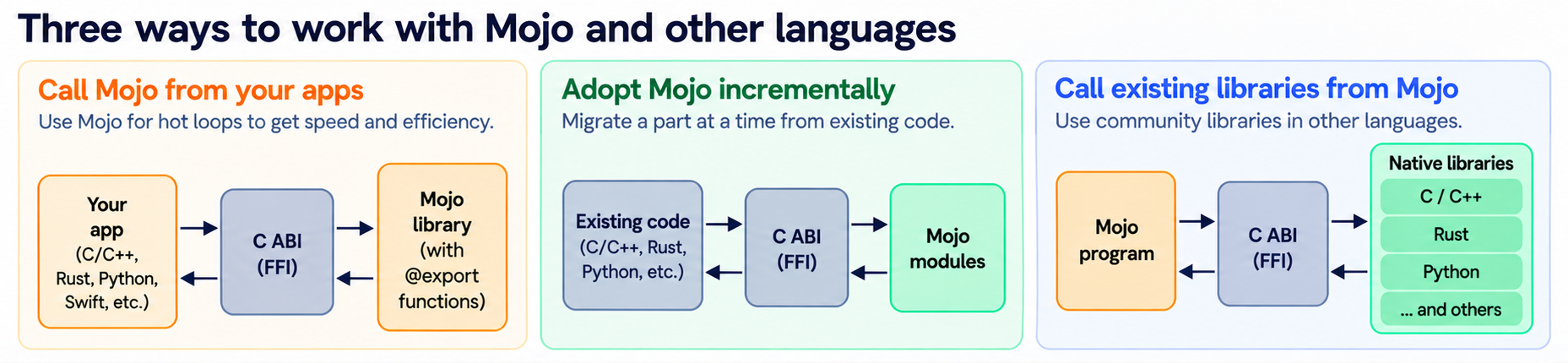
Use Mojo without leaving behind your current code with interoperability. Mojo works side-by-side with many languages. Call functions and share data, while keeping your familiar library and tools. This lets you move your code into Mojo at a pace that works for you.
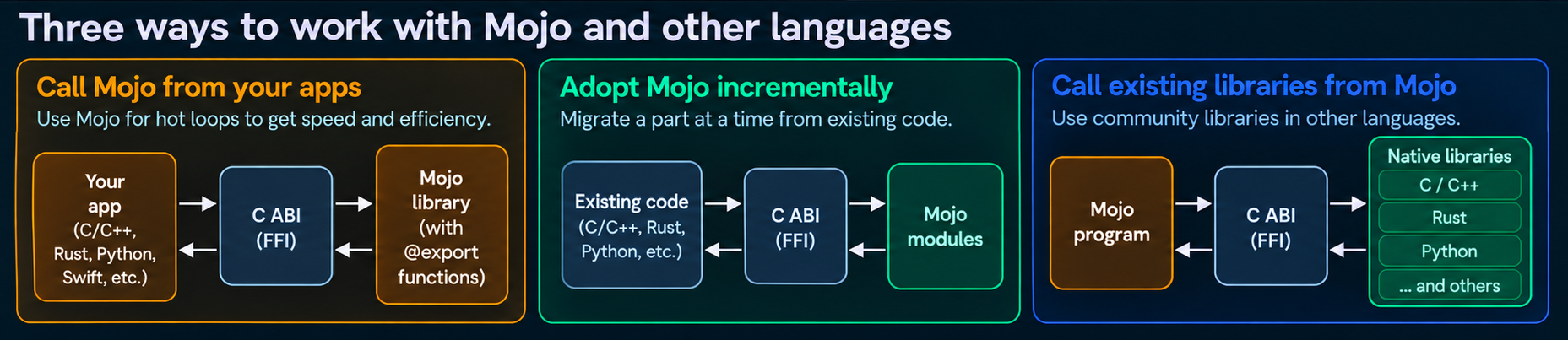
Interoperability has three typical goals:
- More performance. Migrate performance-critical code ("hot loops") into Mojo without rewriting the rest of your application. This lets you keep your existing infrastructure while taking advantage of Mojo's optimizations.
- Broader adoption. With Mojo, you don't need to rewrite everything. Adopt Mojo incrementally, migrate part of an application at a time.
- Expanded libraries. Mojo can call into other languages. Use libraries written in non-Mojo languages from Mojo without reimplementing their functionality.
The C Application Binary Interface (C ABI) supports interop across many languages and platforms. With it, you call functions and share data across language boundaries. Mojo's Python interoperability uses it too, as it's built on CPython's C API.
What is the C ABI?
When code compiled separately calls a function, both sides must agree on a set of rules:
- Which registers hold arguments
- Where do return values go
- How are data types laid out in memory
- How are function names made to appear in the finished binary
These rules are part of an application binary interface (ABI). Code compiled from different languages can call only each other when both sides follow compatible ABI conventions.
Programming languages normally use their own protocols. For example, C++ compilers use name mangling to encode function information in symbol names. GCC, Clang, and MSVC use schemes that aren't always compatible with each other. Rust's default ABI isn't guaranteed to remain stable between compiler versions. These can't provide a universal interface between languages.
Platforms
Using a platform-specific C ABI, rather than a language-specific ABI, has become the common choice for several reasons:
- Operating systems support it. System libraries expose C interfaces, making the C ABI widely supported across platforms.
- It's stable. Changing a platform's C ABI might break existing compiled programs and libraries, so platforms rarely change it.
- Nearly every language supports it. C++ and Rust provide
extern "C", Python's standard interpreter exposes a C API, and Mojo provides theabi("C")effect and the@exportdecorator.
There's no single, universal C ABI. Each platform defines its own conventions. For example, x86-64 Linux generally follows the System V AMD64 ABI, while 64-bit ARM platforms follow variants of the AAPCS64 standard, including Apple's platform-specific conventions.
Interoperability works because compilers targeting the same platform follow
compatible rules. The compiler handles most platform-specific
differences, but some will affect your code. For example, the size of C's
long type depends on the target platform. Mojo's
std.ffi module provides aliases like c_long that
match the platform's C types regardless of their size, so you don't have to
account for those differences manually.
Data representations
A C ABI supports a small set of data representations: numbers, pointers, function pointers, and structs with C-compatible layouts. It doesn't define ownership, lifetimes, or error handling, so both sides must agree on who frees memory, how long pointers stay valid, and how failures are reported.
For the full list of std.ffi type aliases, see C-compatible data
types.
Example: Call Mojo from C
This example builds a Mojo library and calls one of its functions from C, without a wrapper or binding layer. It demonstrates a common use case: writing performance-critical code in Mojo and calling it from an existing application written in C, C++, Rust, or Python.
Three pieces make this work:
@export("add")exports the function with the C symbol nameadd.abi("C")uses the platform's C calling convention.c_longmatches C'slongtype on the target platform.
The function adds two numbers, keeping the focus on calling Mojo from another language:
from std.ffi import c_long  # 64-bit on macOS and Linux

@export("add")
def add(x: c_long, y: c_long) abi("C") -> c_long:
    return x + y
A C program can call the exported Mojo add() function:
#include <stdio.h>

extern long add(long a, long b);

int main(void) {
    printf("sum = %ld\n", add(5, 103));  /* 108 */
    return 0;
}
Build and run on Linux:
mojo build mylib.mojo --emit shared-lib -o libmylib.so
cc main.c -o main -L. -lmylib -Wl,-rpath,'$ORIGIN'
./main
On macOS:
mojo build mylib.mojo --emit shared-lib -o libmylib.dylib
install_name_tool -id @rpath/libmylib.dylib libmylib.dylib
cc main.c -o main -L. -lmylib -Wl,-rpath,@loader_path
./main
Both print:
sum = 108
C calls the Mojo function just like any other C function. The calling
code doesn't need to know it was written in Mojo. Other languages that
support the C ABI, including C++, Rust, and Python through ctypes, can
call the same library.